Cumulative Frequency Histogram Definition. Remember that frequency distribution is an overview of all distinct values or classes of values and their respective number of occurrences. It is the sum of all the previous frequencies up to the current point.
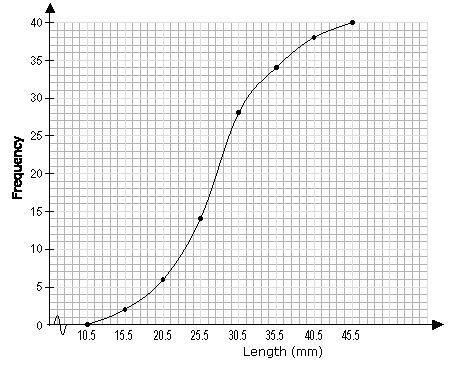
The cumulative histogram is the fraction of pixels in the image with a DN less than or equal to the specified DN. A histogram is an approximate representation of the distribution of numerical data. On a graph it can be represented by a cumulative frequency polygon where straight lines join up the points or a cumulative frequency curve.
Cumulative histograms also known as ogives are a plot of cumulative frequency and are used to determine how many data values lie above or below a particular value in a data set.
Histograms and the cumulative frequency plots are both used to visually study the distribution of a dataset. For example the cumulative frequency up to and including the class interval 834110862 in the previous example is 20 6 3 29 signifying that 29 cars have prices less than 10862 US dollars. Feb 19 2021 A cumulative frequency histogram is a graphical representation of the running totals of the frequencies that occur in a statistical situation that is being measured. The cumulative frequency is calculated from a frequency table by adding each frequency to the total of the frequencies of all data values before it in the data set.
